
Home / Tarot Card Meanings / Major Arcana / The Hierophant
MAJOR ARCANA · V
The Hierophant tarot card meaning: upright, reversed, love and yes or no
The Hierophant tarot card means tradition, commitment and guidance, the shared rules and teachers that hold a community together. Upright, it points to formal steps like marriage or study. Reversed, it shows questioning tradition and doing things your own way. As a yes or no, the Hierophant says yes.
By Angelos · Last updated October 2026 · 15 min read
The card at a glance
| Number | V (5) |
| Element | Earth |
| Zodiac sign and planet | Taurus, ruled by Venus |
| Upright keywords | Tradition, commitment, guidance, shared values |
| Reversed keywords | Breaking the rules, questioning tradition, doing it your own way, rigid dogma |
| Yes or no | Yes, especially for marriage, commitment and formal steps |
Contents
PREMIUM PERSONAL
Want to know what the Hierophant means for you?
A 750+ word personal reading, in your inbox in about 30 minutes.
The Hierophant tarot card symbolism: what the picture shows
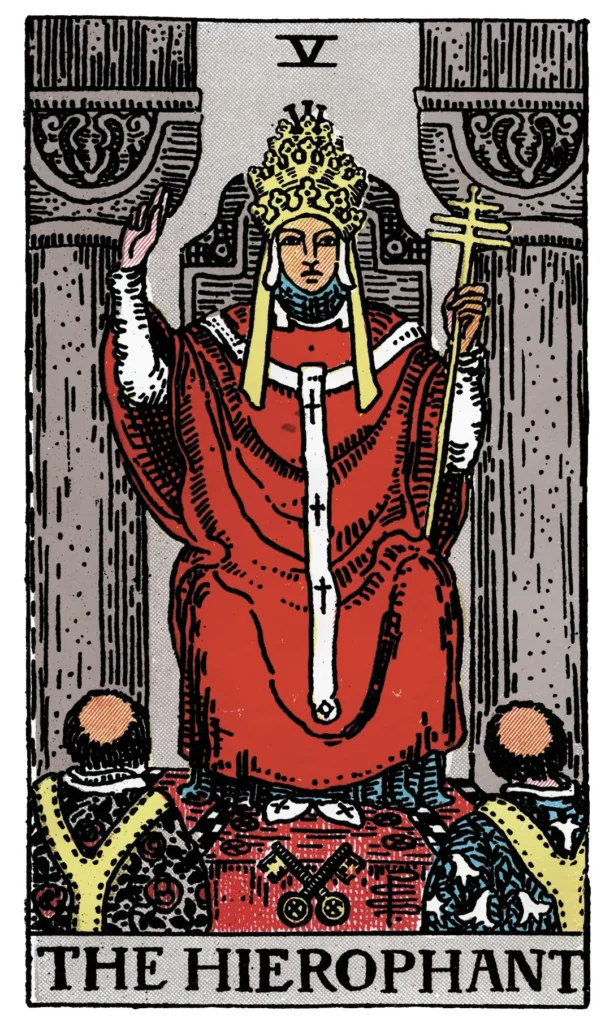
Two men kneel at the bottom of this card, and the whole scene is arranged for their benefit. Their heads are shaved at the crown in the old monastic style, which marks them as students or junior clergy. One wears a robe patterned with roses and the other a robe patterned with lilies, the same two flowers that grow in the Magician‘s garden.
Above them sits the Hierophant in a red robe, with a white stole marked with crosses and a triple crown on his head. The three tiers are usually read as three levels of the world he teaches about, from the physical up to the spiritual. His left hand grips a tall staff topped with a triple cross.
He raises his right hand in blessing, two fingers pointing up. Waite described this gesture as one that separates the open part of a teaching from the hidden part, which is a good summary of the card. The Hierophant gives you the version of the wisdom that can be taught in a classroom.
At his feet lie two crossed keys. They echo the keys of Saint Peter in Christian art, and in tarot they stand for access, the knowledge a teacher can open up for a student who’s ready. He’s seated between two gray stone pillars, a formal, symmetrical setting that looks more like a sanctuary than open countryside.
His name comes from the Greek word for the priest who showed sacred objects to new members of the ancient mysteries at Eleusis. Older decks simply called him the Pope. He’s card five, right after the Emperor, and he’s the first figure in the Major Arcana shown with an audience.
The Hierophant tarot card meaning: the upright card
Weddings, graduations and the family recipe nobody is allowed to change all belong to this card. Upright, the Hierophant stands for the traditions, institutions and shared beliefs that give a group its shape, and for your place inside them. It often appears just before you make something official, like signing up for a program, joining a congregation or setting a wedding date.
Guidance is the other half of the card. The Hierophant is a teacher, and in a reading he can be a real mentor, a professor, a faith leader, a sponsor in a recovery program or a senior colleague who shows you how things are done. He can also be the knowledge itself, a body of training you’re learning step by step, like an apprenticeship, a residency or a long course of study.
The Emperor makes the laws of the land, and the Hierophant teaches what a community believes. Both deal in rules, but the Emperor’s rules are enforced, while the Hierophant’s are passed down and taken on willingly. That difference matters, because this card works best when you agree with the tradition you’re part of.
With the Hierophant I care less about whether a rule is old than whether you’d sign up for it again today, knowing what you know now. If the answer is yes, the card says lean on that structure, because it was built to carry people through a moment like this one.
Conformity is the risk sitting inside the upright meaning. Following the usual path is wise when the path suits you, and the card can also describe someone doing what’s expected out of habit or fear of disappointing family.
The Hierophant tarot card in love and relationships
Commitment is the Hierophant’s main subject in love. This card describes love done the traditional way, dating with intention, meeting the family, getting engaged and making it official in front of people who matter to you. Beyond the wedding itself, it speaks to the values two people share and the small rituals that hold a couple together over time.
If you're single
Someone with values like yours is more likely to turn up through your community than through endless swiping. The Hierophant points to introductions from friends or family, a congregation, a volunteer group or a class where you see the same faces every week. It also favors dating with a clear idea of what you want long term. If you’ve been on dates with people who want something casual while you want a partner, the card suggests saying so early, since compatibility on the big questions matters more here than chemistry on a first date.
If you're in a relationship
A formal next step often comes with this card, like an engagement, a wedding, a commitment ceremony or a decision to blend families. Premarital counseling fits too, or a couple sitting down to talk through faith, holidays and how they’d raise kids. When two people come from different backgrounds, the Hierophant asks which traditions each of you wants to keep and which you’re ready to build together. The card supports structure in a relationship, like a standing date night or a shared budget, as long as both of you chose it.
Reconciliation and your ex
Reconciliation with this card usually goes through a structure instead of a late-night text. It favors couples counseling, a mediated conversation or a slow return with clear agreements about what changes this time. Family or a shared community may play a part, for better or worse. If you’re divorcing or separating, the Hierophant can also describe the formal process itself, the paperwork and the legal steps, and a family lawyer or mediator is the right guide for those.
The Hierophant as feelings: how someone feels about you
Respect is at the center here. The person may see you as someone to build a life with and want to do things right, slowly and in the open. There can be real romance, though it’s often expressed through loyalty and plans more than grand gestures. Family expectations or beliefs may shape how fast they move. The card shows steady feelings more than wild ones.
The Hierophant as intentions
The intentions here are serious. The Hierophant describes someone thinking about commitment, introductions to family and possibly marriage, and wanting to go about it the expected way. Their timeline may be more traditional than yours, so it helps to talk about it.
How someone sees you
What stands out to this person is likely your sense of right and wrong, along with a steadiness that would make you easy to bring home to their family. They may come to you for advice, even if you sometimes seem more traditional than they are.
Want to know what the Hierophant means for you? The Hierophant usually points at one tradition or commitment in particular, and figuring out which one is where a personal reading starts. With a Premium Personal Tarot Reading you get 750+ words written for you personally, with Future Now™ delivery to your inbox in about 30 minutes on average. If anything is unclear, follow-up questions are free.
Complete confidentiality · 100% secure payment
The Hierophant tarot card in career and money
Big institutions are this card’s workplace, like universities, hospitals, government agencies, banks, law firms and established companies with a clear chain of command. Formal hiring processes call for patience with this card. The card leans yes, on the employer’s schedule, so expect structured interviews, references and paperwork, and treat them as part of how the system works.
It’s also a strong card for training and credentials. Certifications, licensing exams, graduate school and apprenticeships all fit, along with finding a mentor who has done the job for twenty years. If you’re new somewhere, the card says learn the culture before you try to change it.
Money gets conservative treatment from this card. It favors established banks, steady saving and advice from a licensed professional over hot tips from social media. A fee-only financial planner, a tax preparer or your HR benefits office is where this card would send you.
The Hierophant as a person
In a spread about someone in your life, the Hierophant usually points to a mentor or a keeper of tradition. That could be a faith leader of any religion, a teacher with thirty years in the classroom or the grandmother who runs every holiday the same way. They’re knowledgeable and patient with beginners, and they believe in doing things the way they’ve always been done because they’ve seen it work. People trust them with big moments, from weddings to career advice. The flip side is rigidity, a person who can’t hear a new idea without quoting the rulebook. Men and women both fit the card, and it often points to an older person or someone with formal authority in a group.
The Hierophant reversed meaning
Questioning the rules is healthy, and the reversed Hierophant is where that questioning lives. This card reversed often appears when a tradition, belief or institution no longer fits you, and you’re working out what to keep.
It might look like leaving the faith community you grew up in, dropping out of a program that was your parents’ dream or deciding you don’t want the wedding everyone expects. Doing it your own way is a real option with this card, and the card wants you to choose your path on purpose instead of rebelling against everything at once. Some rules are worth breaking and some were protecting you.
The reversal can also describe rigid dogma, a group or a person who enforces rules for their own sake and punishes questions. A workplace that runs on “That’s how we’ve always done it” or a family that expects obedience fits here, and the card supports your right to step back from it.
Upside down, the picture puts the two kneeling students above their teacher. Some readers use that image for the student who has outgrown the lesson and now has to find their own way to apply it.

The Hierophant reversed in love
This reversal often turns up for couples writing their own script, like partners who don’t plan to marry, who elope instead of throwing a big wedding or who come from different faiths and blend them their own way. Pressure from family or a community to fit a mold may be part of the picture, or a relationship that looks right on paper and feels wrong to the people in it.
The Hierophant reversed in career and money
Leaving a traditional career path fits the reversal, say a law firm for a nonprofit or a corporate job for a business of your own, along with clashing with rules that make no sense. It also asks you to question financial advice that doesn’t fit your situation, while still checking any unconventional plan with someone qualified.
The Hierophant reversed as feelings
The card shows torn loyalty here, someone who may care about you and still feel pulled back by what their family or upbringing expects, or someone restless inside a relationship that feels too scripted.
The Hierophant reversed as a person
A rebel or a free thinker on one side, and on the other a rigid authority who confuses rules with values. Neither one finds the middle ground easily.
The Hierophant reversed: yes or no
No, not by the usual route. If you change the plan to fit what you actually want, the answer can change with it.
The Hierophant reversed as advice
Pick one rule you follow without thinking and ask where it came from. Keep it if it still serves you, and if it doesn’t, replace it with something you’d choose on purpose.
Is the Hierophant a yes or no card?
Yes, especially for marriage, commitment and anything that goes through official channels. The Hierophant favors applications, ceremonies, enrollments and agreements made in good faith. Its yes still runs on the institution’s timeline, so a process with forms and committees may take longer than you’d like.
For pregnancy or a health worry, the Hierophant’s own advice applies. Ask someone trained, which here means a doctor.
The Hierophant as timing: when will it happen?
Taurus rules the Hierophant, and the sun moves through Taurus from April 20 to May 20, in the middle of spring. That stretch, the start of wedding season in much of the US, is the card’s natural time of year.
Beyond the zodiac, the card runs on official schedules. Things happen when the institution says they will, like the start of a semester, the date a license is issued or the day a ceremony was booked months ago. The pace is steady and rarely fast.
The Hierophant as advice, action and outcome
The Hierophant as advice
Find someone who knows more than you and learn from them. That might mean asking a mentor for an hour of their time, joining a group that does what you want to do or following a proven method before inventing your own. When a decision involves people you love, the card also asks you to respect the traditions that matter to them.
The Hierophant as action
Make it official, by filing the application, setting the date, taking the vows or signing up for the course. If the question is about another person, the card describes someone who checks with an elder or a counselor before making a move.
The Hierophant as an outcome
This outcome is a commitment made formal, a credential earned or a place inside a group you chose. The result usually comes with a ceremony, a certificate or a signature attached.
The Hierophant in the past, present and future positions
Your upbringing usually comes into view when the Hierophant lands in the past position, meaning the faith, school or family rules you grew up with and still measure yourself against.
Drawn for the present, it puts the focus on a formal step you’re taking, like an engagement, a training program or a new role in your community.
Still to come, the card shows a commitment becoming official or a teacher arriving when you need one.
The Hierophant and the zodiac signs
The Hierophant belongs to Taurus, a fixed earth sign ruled by Venus, and the sign shares the card’s love of what’s proven, lasting and worth passing down.
Taurus usually feels at home with this card, and the reversal is the stretch for it, since the bull doesn’t give up a familiar routine without a fight. Aquarius, the zodiac’s rule-questioner, often relates to the reversed card first and gets more from the upright one, which shows the value of a tradition worth keeping. Sagittarius, the sign of higher learning and big beliefs, shares the Hierophant’s interest in teachers and usually wants to pick its own.
The Hierophant tarot card combinations
The Hierophant takes on a different job with each of these seven cards.
The Hierophant and the Lovers: The classic marriage pairing. Love and commitment line up, and a relationship may move toward vows or a formal promise. See the Lovers card meaning.
The Hierophant and Two of Cups: Love that wants a ceremony. This pair often shows an engagement or two people agreeing on what they are to each other. See the Two of Cups card meaning.
The Hierophant and the Ten of Cups: Family life built on shared values. Weddings, holidays together and a household that keeps its traditions fit this pair.
The Hierophant and the Emperor: Rules from two sources. Institutions, law and tradition all point the same way, and the pair favors working within the system. See the Emperor card meaning.
The Hierophant and the High Priestess: Doctrine and instinct. The lessons you were taught meet your own intuition, and you may need to decide which one to trust. See the High Priestess card meaning.
The Hierophant and the Devil: A tradition that has turned into a trap. Strict rules, guilt or a controlling group may be keeping you somewhere you don’t want to be. See the Devil card meaning.
The Hierophant and Justice: Contracts and formal agreements. Marriage licenses, legal documents and official decisions are favored when everything is done by the book. See the Justice card meaning.
The Hierophant tarot card: frequently asked questions
Is the Hierophant a positive card?
Yes. The Hierophant stands for commitment, good teachers and the support of a community. It becomes less comfortable when the tradition in question no longer fits you, and then it asks whether you’re following the rules because you believe in them or because you were told to.
Is the Hierophant a yes or no card?
Yes, especially for marriage, commitment and formal steps like applications or contracts. Reversed, it’s no, not by the usual route. Questions about health or pregnancy belong with a doctor.
Does the Hierophant mean marriage?
It’s one of the two cards most often linked to marriage, the other being the Lovers. The Hierophant points to commitment made formal, like an engagement, vows or a ceremony. It shows the direction a relationship is heading, while the couple’s own choices decide whether and when a wedding happens.
Does the Hierophant show romantic feelings?
Yes, though they’re expressed in a traditional way. Feelings built on respect and long-term intentions are what this card shows, in someone who wants to take things seriously. Romance with the Hierophant leans toward loyalty and plans more than passion and drama.
What does the Hierophant reversed mean?
The Hierophant reversed means breaking the rules, questioning tradition and doing things your own way. Sometimes it describes rigid dogma instead, a group or person enforcing rules for their own sake. In love, it often describes a relationship that doesn’t follow the expected script.
Is the Hierophant the same as the High Priest?
Some modern decks do call him the High Priest, and older decks named him the Pope. He’s the male counterpart of the [[High Priestess|https://tarotvista.com/en/the-high-priestess-tarot-card-meaning/]], card two. She keeps hidden knowledge, while he teaches the public, shared version. The figure on the card is male, but in a reading he can stand for anyone.
What is the Hierophant trying to tell me?
That you don’t have to figure this out alone. The card points you toward a teacher, a tradition or a community that has already dealt with your question. It also asks whether the rules you’re living by are ones you’d still choose.
The Hierophant tarot card: quick summary
| Upright | Tradition, commitment and guidance from a teacher or community |
| Reversed | Breaking the rules, questioning tradition or rigid dogma |
| Love | Commitment, marriage and shared values. With an ex, reconciliation through counseling or clear agreements |
| Career and money | Institutions, training and credentials. Conservative money choices |
| Health | Conventional care and expert advice. Tarot doesn’t diagnose, so take medical questions to a doctor |
| Yes or no | Yes, especially for marriage, commitment and formal steps. Reversed, no, not by the usual route |
| Timing | On the institution’s schedule, or Taurus season, April 20 to May 20 |
The bottom line on the Hierophant
The Hierophant says you’re part of something larger than yourself, a family, a faith, a profession or a community, and that its wisdom is there for you to use. Take what serves you and question what doesn’t. Make your commitments with your eyes open.
Whether it’s a wedding date or a rule at work you’re tired of following, the cards can help you decide which commitments to keep. A Premium Personal Tarot Reading gives you 750+ words on your question, with Future Now delivery to your inbox in about 30 minutes on average. Follow-up questions are free, as many as you need.
Complete confidentiality · 100% secure payment
Angelos
Certified Master of Prophetic Arts
Last updated October 2026